 Transitour

How to Improve Quote Conversion in Coach and Tour Operations

Why quote conversion matters for coach operators
A busy inbox does not necessarily mean a healthy sales pipeline. For coach and tour transport companies, the more useful question is how many enquiries and quotations actually become confirmed work. Improving quote conversion for coach operators can increase revenue without requiring the business to generate the same increase in new enquiries.
Conversion can be affected by several practical factors: how quickly the customer receives an answer, whether the quote contains the right information, whether pricing is consistent, whether open quotes are easy to track and whether management can see what is actually converting.
This makes quote conversion more than a sales metric. It is also an operational one. The quotation has to reflect the real trip, the right vehicle requirements, the route and the pricing rules that the operator is prepared to deliver.
What is quote conversion?
At its simplest, quote conversion measures the proportion of quotations that turn into confirmed bookings.
If an operator sends 100 quotations and 35 become bookings, the quote conversion rate is 35%. The calculation is straightforward, but interpreting the number requires more context.
Operators should avoid looking at conversion in isolation. A high conversion rate based on aggressive pricing may not produce the best margins. A lower rate may also be perfectly reasonable for certain types of enquiry, customers or high-value trips.
The useful question is therefore not only “What is our conversion rate?” but also “Why are we winning or losing these quotations?”
How to improve quote conversion for coach operators
1. Respond while the enquiry is still active
Customers requesting group transport are often comparing several operators. A quotation that arrives after the customer has already received and reviewed other options starts at a disadvantage.
This does not mean that teams should sacrifice accuracy for speed. It means reducing the unnecessary work between receiving an enquiry and being able to prepare a reliable quotation.
Customer, route, passenger, timing and vehicle requirements should be captured in a structured way so that the team does not need to repeatedly search through emails or messages before pricing the trip.
For operators receiving enquiries outside office hours or through multiple channels, AI-assisted lead capture can also help collect and qualify information from web and WhatsApp enquiries before the team reviews the request.
2. Make pricing consistent and repeatable
Slow quoting is not the only conversion problem. Inconsistent pricing can also make it difficult to compete confidently.
If similar jobs are priced differently depending on who prepares the quote, which spreadsheet they use or what they remember from the previous booking, the operator has limited control over both conversion and margin.
Structured rate cards and pricing rules provide a stronger foundation. Depending on the service, pricing may need to reflect factors such as route, distance, time bands, minimum charges, customer-specific rates or multi-stop journeys.
Transitour supports configurable pricing and rate cards so that operators can maintain structured pricing rules instead of rebuilding every quotation from scratch.
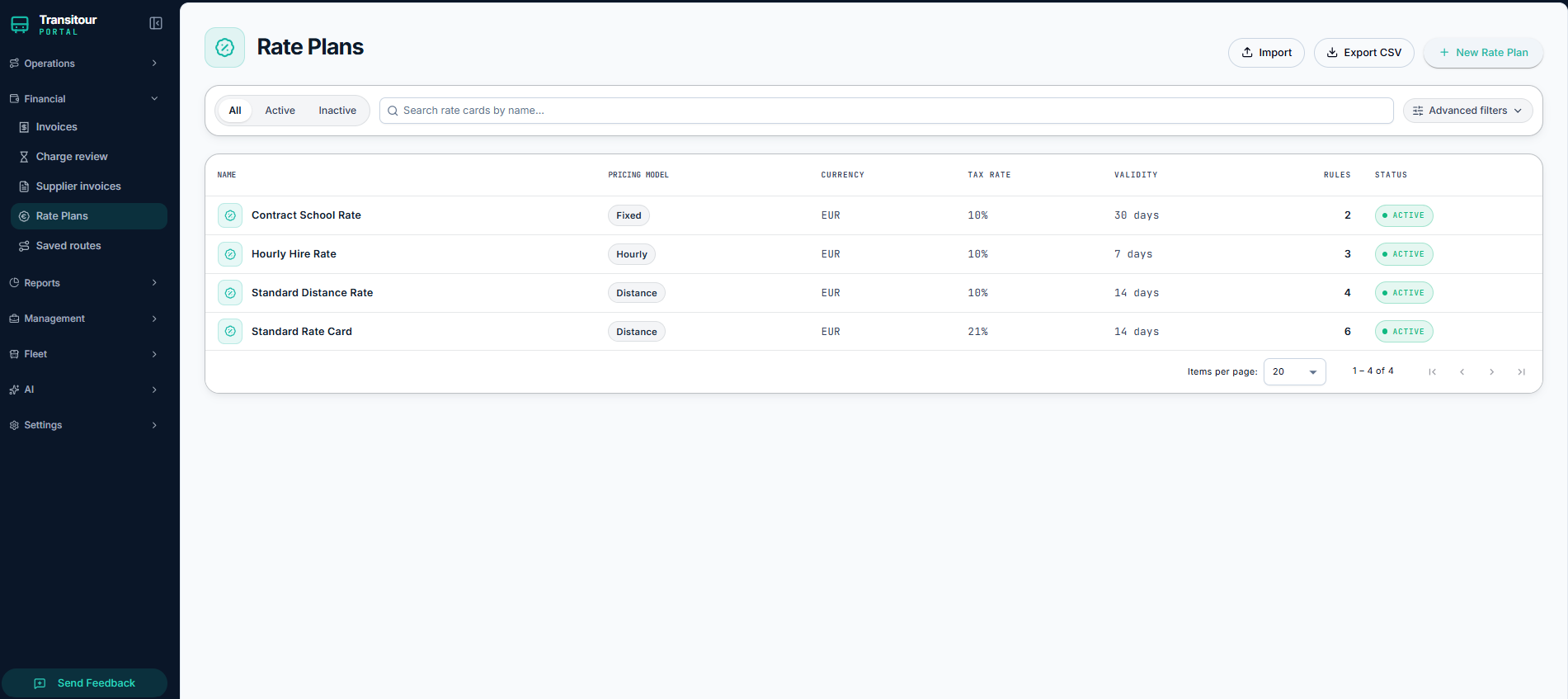
Structured rate cards help coach operators apply more consistent pricing when preparing customer quotations.
3. Give every quote a clear status
A quotation should not disappear once it has been sent.
As quote volumes increase, teams need to know which quotations are still being prepared, which have been sent and which have already been accepted or are no longer active.
Without that visibility, commercial opportunities can remain buried in individual inboxes or spreadsheets. The problem becomes particularly difficult when several people answer enquiries or manage the same customer accounts.
A dedicated quote management process gives the team a common view of outstanding commercial opportunities and their status.
Transitour provides a quotations view where operators can manage and distinguish between quote statuses such as draft, sent, accepted and expired.
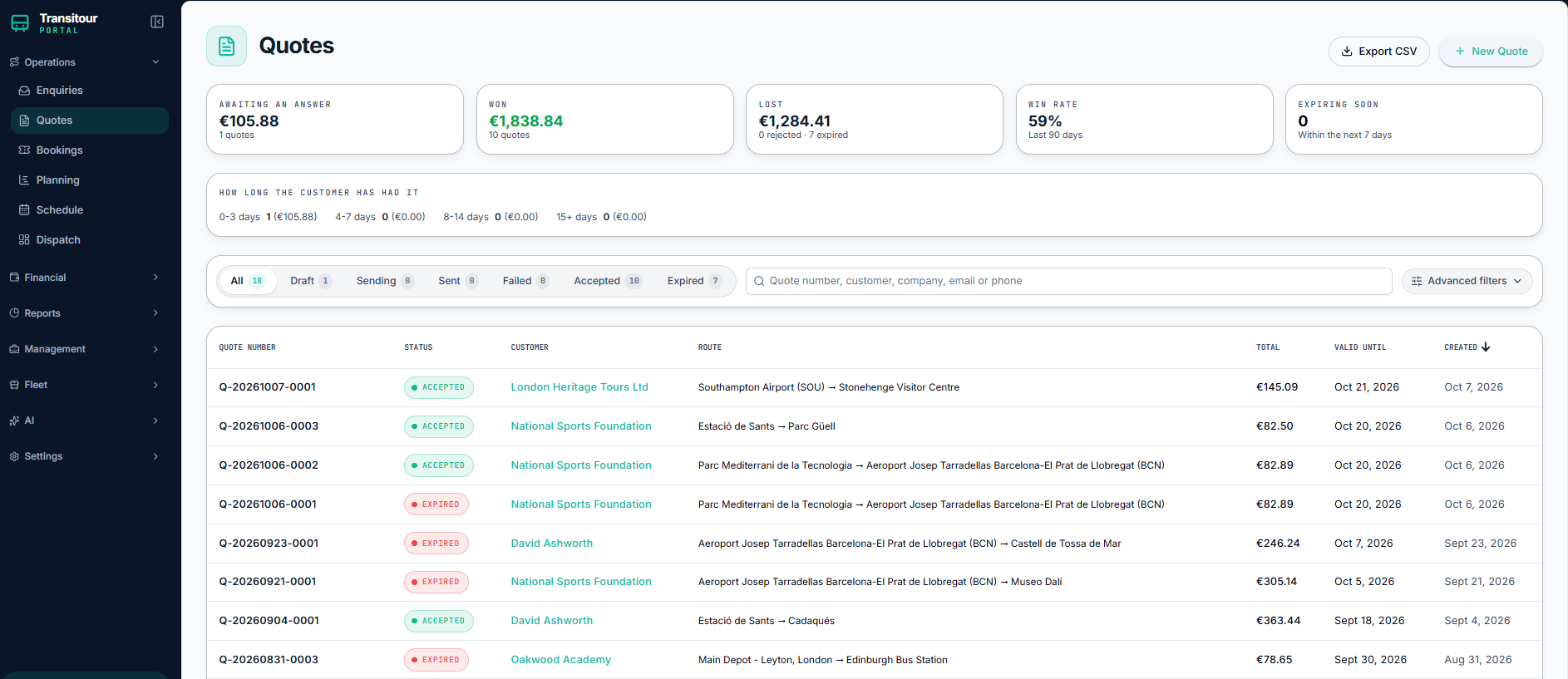
Quote tracking gives teams visibility over commercial opportunities before they become confirmed bookings.
4. Improve the information behind the quote
A fast price is not useful if important information is missing.
Passenger numbers, pickup and destination points, dates, times, stops and required vehicle type can all affect the quotation. Missing details can lead to repeated questions, revisions or a price that later has to be changed.
A more structured enquiry process helps the operator prepare a quote that is both faster and more reliable.
This is especially important for coach tours, airport transfers, events and multi-stop transport, where relatively small differences in the itinerary can affect distance, vehicle requirements, waiting time and operational feasibility.
5. Measure conversion instead of relying on impressions
Teams often have a general feeling about whether quoting is going well. Management needs something more useful than a feeling.
Quote conversion should be reviewed alongside other commercial and operational information. For example:
- How many quotes were prepared?
- How many became confirmed bookings?
- How has conversion changed over time?
- Are quotation volumes increasing without a similar increase in bookings?
- Is revenue increasing along with conversion?
Transitour's revenue reporting includes quote conversion alongside information such as bookings, invoices, income and pending revenue. This helps managers connect quoting activity with actual business performance rather than analysing quotations as an isolated administrative task.
Do not judge conversion too quickly
Quote conversion also needs the right time frame.
A quotation sent yesterday may still be waiting for the customer's decision. If management measures a very recent period as though every quote were already won or lost, the result can make performance look worse than it really is.
It is therefore useful to compare consistent periods and allow enough time for open quotations to mature before drawing conclusions.
The same principle applies when comparing different types of work. A simple airport transfer and a large multi-day coach tour may have very different decision cycles. Combining everything into a single percentage can hide useful information.
Conversion and profitability are not the same thing
Winning more quotations is valuable, but winning every quotation should not be the objective.
An operator could theoretically improve conversion by lowering prices until nearly every customer says yes. That would be a poor commercial strategy if margins disappear at the same time.
This is why quote conversion should be considered together with structured pricing, revenue and operational capacity. The best outcome is not simply more accepted quotes. It is more of the right bookings at prices the operation can deliver sustainably.
For coach and tour companies, this becomes particularly important during busy periods. Accepting too much work at weak margins can create pressure on vehicles, drivers and schedules without producing the expected financial result.
What to look for in coach quoting software
If quote conversion is becoming difficult to manage manually, specialist coach quoting software should help the team create a more controlled commercial process.
Useful capabilities include:
- centralised quotation records;
- clear quote statuses;
- configurable pricing and rate cards;
- customer and trip information connected to the quotation;
- support for multi-stop routes and different vehicle requirements;
- conversion reporting;
- a clear route from an accepted quote to a confirmed booking;
- AI-assisted enquiry capture where appropriate.
The objective is not to add another sales tool to the stack. It is to give coach and tour transport teams better control over the point where an enquiry becomes real business.
Improve quote conversion with better operational data
Improving quote conversion for coach operators does not come from one trick. Faster responses help. Better pricing helps. Clear quote statuses help. More complete enquiry data helps. Measuring the results helps.
Together, these improvements give operators a more repeatable way to turn customer enquiries into profitable bookings.
Transitour connects quotations, configurable pricing, bookings and reporting in a platform designed for coach, bus and tour transport operations.
Want to see where your quotation process could become faster and easier to measure? Book a Transitour demo or start your free trial and test the workflow with your own operation.