 Transitour

Recurring Transport Software: How to Manage School Runs and Corporate Shuttles

Running the same school route every weekday or the same employee shuttle every morning should not mean rebuilding the same operational work again and again. Recurring transport software gives coach and bus operators a structured way to manage services that repeat across weeks or months, while keeping routes, contracts, schedules and operational resources connected.
This is particularly useful for school runs, employee transport, corporate shuttles, university routes and other contract services where the journey may be familiar but the operational commitment is ongoing. The challenge is not simply creating one trip. It is managing the entire series reliably.
Why recurring transport is different from one-off coach hire
A private hire booking may happen once. A recurring service creates a commitment across a much longer period.
A school contract, for example, may require the same pickup pattern every Monday to Friday throughout a term. A corporate shuttle might run several times each weekday between a station and an office, warehouse or production site. Other contracts may operate only on selected days or during specific months.
That changes the operational question. Instead of asking, “How do we schedule this trip?”, the team has to ask:
- Which days does the service operate?
- When does the agreement start and end?
- Which client and contract does it belong to?
- Which pickup and destination locations are reused?
- How many future trips does the commitment create?
- Which vehicles and drivers will be available across those dates?
- What happens when one journey in the series changes?
Managing those questions with separate calendar entries or copied spreadsheet rows creates repetitive administration and makes future commitments harder to see.
What recurring transport software should help operators control
A useful recurring transport system should treat repeated work as a service pattern rather than as dozens of unrelated bookings.
1. A defined operating period
Recurring services normally have a clear duration. School transport may follow an academic term or year, while an employee shuttle may be linked to an ongoing corporate transport agreement.
Recording start and end dates makes the commitment visible as a defined operating period rather than an indefinite collection of diary entries.
2. A repeatable weekly schedule
The frequency of the service should be structured. A route might operate Monday to Friday, only on certain weekdays or according to another repeated pattern.
This is one of the biggest differences between ordinary scheduling and recurring trip management: the team defines the pattern once and uses it to organise the trips that follow.
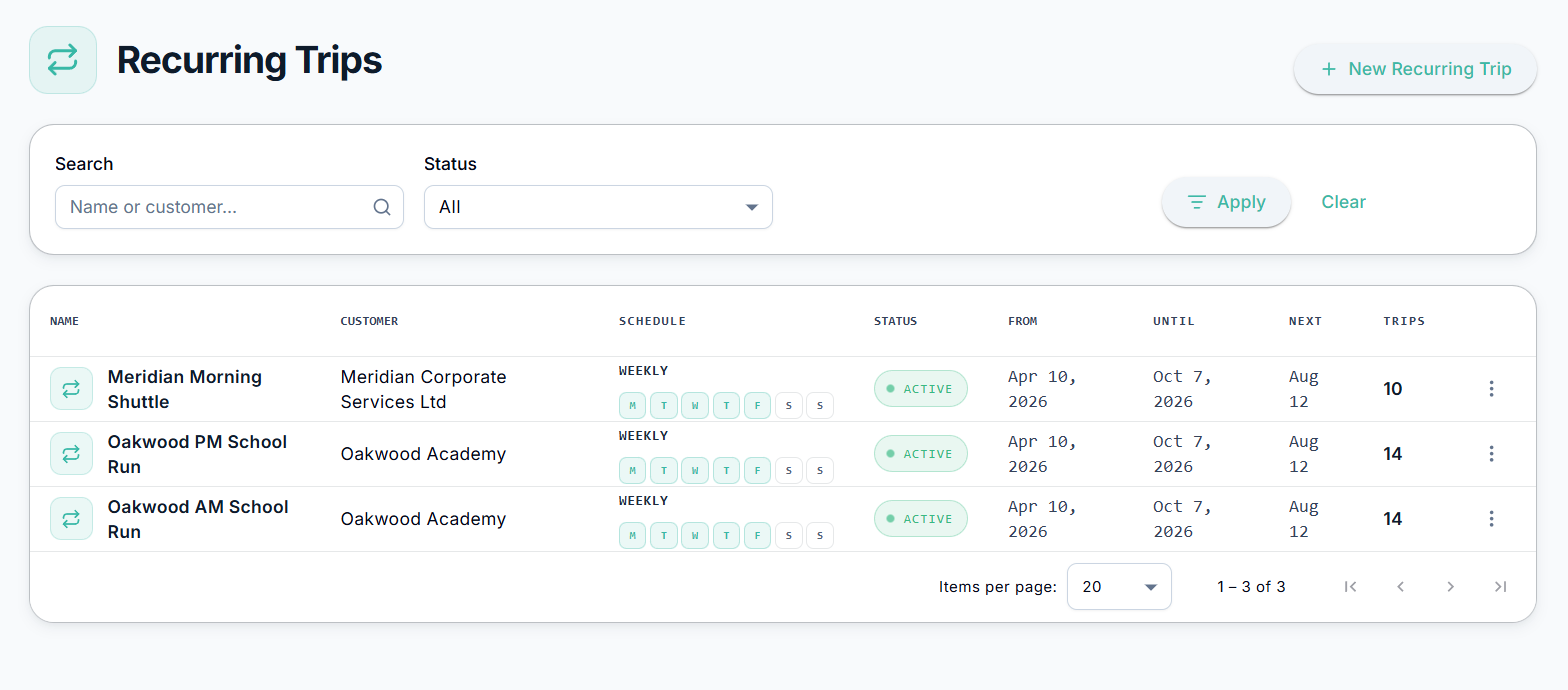
Suggested caption: Transitour keeps recurring school runs and shuttle schedules organised around clients, operating days and service periods.
3. Reusable locations and routes
School runs and corporate shuttles often return to the same places every day: schools, depots, railway stations, offices, hotels, factories or designated pickup points.
Saved locations and structured multi-stop routes reduce the need to repeatedly enter the same operational data. They also help teams keep location information consistent when several people are working on the same contract.
4. A connection between the service and the client contract
Recurring transport is frequently contract-based. The operational schedule should therefore be understood in the context of the agreement that generated it.
Transitour includes contract management for school, corporate and other long-term transport agreements, allowing recurring operational work to remain connected to the relevant client relationship rather than becoming an isolated collection of trips.
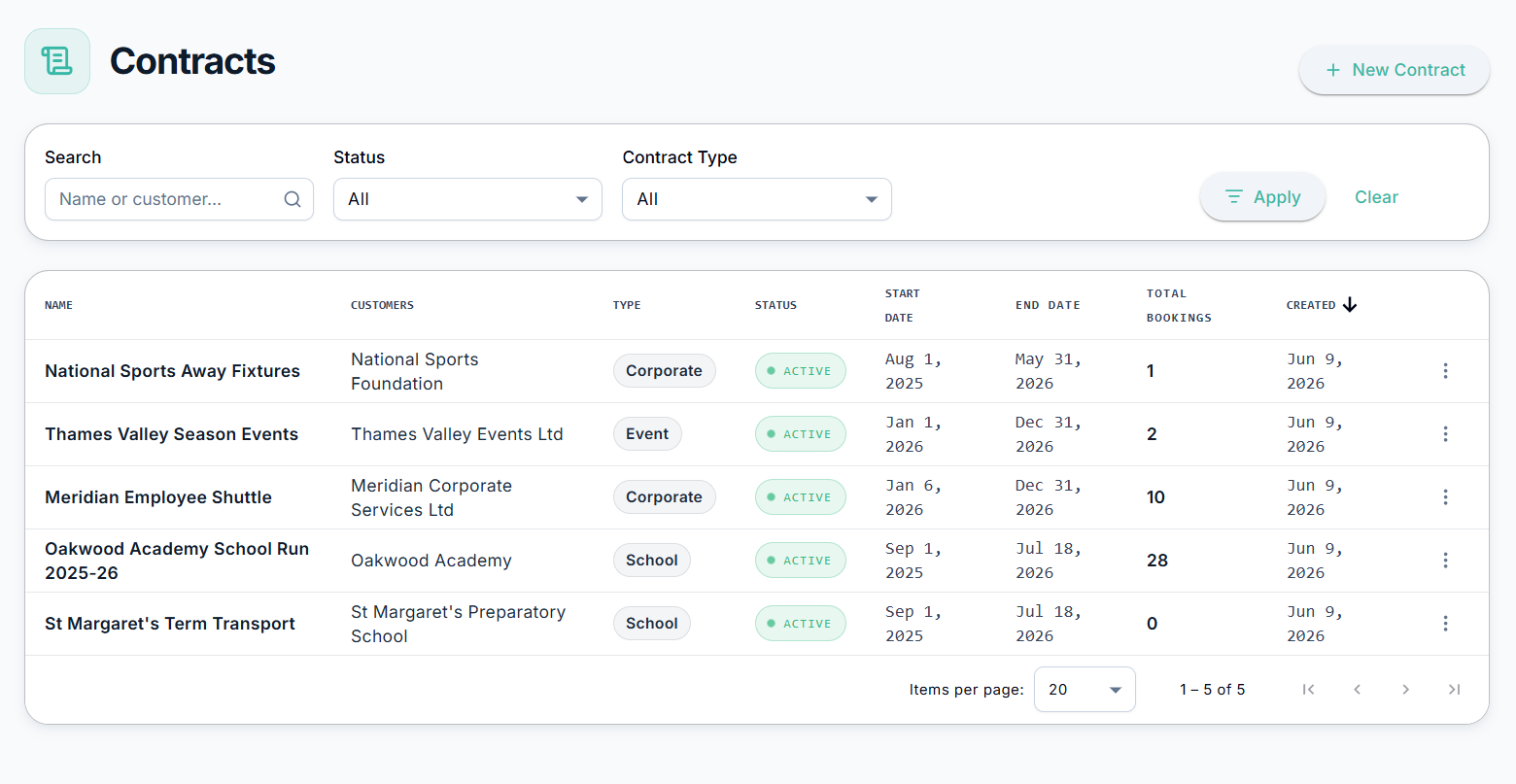
Contracts give operations teams a clear view of long-term school and corporate transport agreements and their related bookings.
School runs: reducing repetitive planning without losing control
School transport is one of the clearest examples of recurring operations. Routes can run hundreds of times during an academic year, yet many of the underlying details remain stable: client, operating days, pickup points, destination, vehicle requirements and expected times.
Creating each journey manually adds little operational value. It mainly creates more opportunities for duplicated data, inconsistent dates or forgotten entries.
With a structured recurring-trip setup, an operator can establish the service pattern and generate the required scheduled work from it. Transitour is designed to generate weeks of recurring trips for bus operations and to support conflict checking across operational resources.
The result is not that school transport becomes completely static. Holidays, special events, vehicle changes and individual exceptions will still need operational attention. The benefit is that the normal service does not have to be rebuilt every time.
Corporate shuttles: manage the commitment, not just today's journey
Corporate shuttle management software addresses a similar problem in a different environment.
An operator may have a contract to transport employees from a railway station to a business park every weekday, connect several company sites or provide transport around shift start and finish times.
For the client, this is one transport service. Operationally, however, it can represent hundreds of individual journeys over the life of the agreement.
That makes visibility over the recurring commitment important. Operations teams need to know what has already been scheduled and what fleet capacity will be required next week or next month, rather than discovering each requirement only when it appears on the daily board.
Recurring services consume future capacity
One reason recurring transport deserves its own workflow is that every contract reserves operational capacity before many one-off bookings even arrive.
Suppose a vehicle is expected to cover a school run every weekday morning and afternoon. Those hours are effectively committed before the sales team considers additional private hire work.
The same applies to drivers. A corporate shuttle that runs every weekday may look simple on a calendar, but it creates repeated driver and vehicle requirements that have to coexist with tours, airport transfers, events and other contracted work.
This is where recurring services and scheduling need to remain connected. Transitour supports vehicle and driver management, scheduling and assignment so operations teams can work with the recurring demand alongside the rest of the fleet workload.
Do not turn every repeated journey into manual data entry
Many transport companies initially manage contract work by copying last week's spreadsheet, duplicating calendar events or creating similar bookings one at a time.
The method may work when there are only a handful of journeys. The administrative burden grows differently from the number of contracts, however. A single five-day-per-week school contract can create hundreds of services over a year.
The important efficiency gain is therefore not simply “faster booking”. It is reducing the amount of repetitive work required to maintain a dependable forward schedule.
A recurring transport system should help teams define stable information once and focus their attention on what actually changes.
What should remain consistent across a recurring service?
For each school run, corporate shuttle or regular contract route, it helps to separate relatively stable information from day-to-day operational decisions.
Information that may remain consistent includes:
- the client or organisation;
- the contract period;
- the normal days of operation;
- standard pickup and destination locations;
- the usual route or stops;
- expected passenger or vehicle requirements.
Operational decisions such as a particular driver or vehicle assignment may still need to reflect actual availability.
This separation matters because the recurring service defines what must be delivered, while scheduling and resource allocation determine how it will be delivered on a particular date.
How Transitour supports recurring transport operations
Transitour brings together several capabilities that are directly relevant to recurring school, shuttle and contract work:
- Recurring trips for repeated routes and scheduled services.
- Contracts for school, corporate and other long-term client agreements.
- Saved locations for frequently used pickup points, destinations, stations, depots and venues.
- Multi-stop routes for services with several operational stops.
- Vehicle and driver management to support resource allocation.
- Scheduling to view recurring commitments alongside other work.
- Fleet bases for operators managing vehicles across more than one depot or operating location.
The aim is not to make every recurring service identical. It is to give the repeated elements a structure, so the operations team spends less time recreating known information and more time managing genuine exceptions and capacity decisions.
Choosing recurring transport software
If recurring services are an important part of your business, evaluate software around the way those contracts actually operate rather than simply checking whether it has a calendar.
Useful questions include:
- Can we define a repeated service instead of entering every journey separately?
- Can we see the operating days and start and end dates clearly?
- Can recurring work remain connected to a client or contract?
- Can we reuse regular locations and multi-stop routes?
- Can the scheduled trips be planned alongside one-off bookings?
- Can vehicle and driver allocation use the same operational data?
- Can the system support both school and corporate contract work?
For operators with a growing volume of repeat business, these questions are often more useful than asking how many generic features a platform contains.
Turn repeat work into a repeatable process
School runs and corporate shuttles are valuable because they create predictable work. They should not also create predictable administrative duplication.
Recurring transport software gives operators a better way to structure long-running services around schedules, contracts, locations and operational resources while keeping future commitments visible.
If your team is still recreating the same school routes or shuttle services week after week, book a Transitour demo or try Transitour free for 7 days and see how recurring trips can fit into your existing operation.